In November 2016, I tweeted:
The “Muslims Condemn” project was a public-facing campaign that emerged in the wake of high-profile terrorist attacks. Like other Muslims and Muslim-led organizations, I felt pressured by headlines and politicians to “prove” we opposed violence. This was in stark irony in the context of my history classes, wherein we discussed historical and colonial violence, often given geopolitical context and divorce from religious motivations and norms, a nuance seldom afforded to the amorphous identity given Islamic terrorism. Thus, a spreadsheet – then turned website – was born.
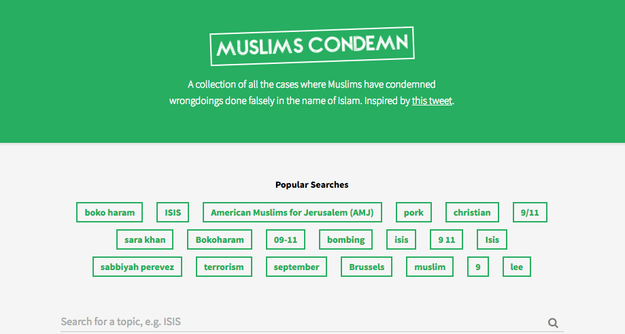
My Google Sheet cataloged links to statements from Muslim individuals, mosques, and major organizations condemning extremist violence, so anyone asking “where are the condemnations?” could be pointed to a single, searchable list. It spread quickly on social media and in the press because it made something very visible that had long been true: condemnations were already happening all the time, but they were routinely ignored, forgotten, or treated as insufficient.
Later on, the spreadsheet also highlighted the deeper double standard baked into the question itself. Whole communities were being asked to account for crimes they didn’t commit, expected to perform public loyalty rituals on demand, while other groups are rarely treated as collectively responsible for violence associated with someone claiming their identity. Even when Muslims condemned attacks immediately and repeatedly, the goalposts often moved (“not loud enough,” “not the right people,” “now condemn this other thing”), which revealed that the issue wasn’t information but suspicion. It’s very existence pointed to how insistence on condemnation can reinforce collective guilt and fuel anti-Muslim sentiment than resolve any standing concerns on Muslims’ moral values.
 H.H.
H.H. 